
Gather what you have noticed
Save three examples and the questions you most want answered.
Resource Library/Start Here
Your first 30 daysOne next step today, then a simple map for the month.

Choose where you’re starting. We’ll show you the most useful next steps.
Note what happened and when. You do not need to diagnose it.
Save three examples and the questions you most want answered.
Use the public program for your child’s age and start the medical or developmental evaluation path.
A child can receive support for communication, sensory, feeding, motor, emotional, or school needs without waiting for every answer.
Contact only two or three relevant programs or providers, learn the payment route that applies, and save the answers in one place.
You do not need to finish everything in 30 days; you only need to know your next step.
You do not have to absorb or act on all of it today.
Write down questions for the evaluator or pediatrician and keep the report somewhere easy to find.
Focus on communication, sensory needs, feeding, motor skills, emotional support, school participation, daily living, and your family’s priorities—not a preset package.
Contact two or three relevant options and compare what each approach is designed to help with.
Pick one or two priorities for the next month, learn the payment route that applies, and keep community options available without making them mandatory.
You do not need to finish everything in 30 days; you only need to know your next step.
You do not have to line up everything at once. Choose one need below and come back for the rest.
 Find a provider
Local therapy and healthcare providers, gathered and checked by parents. Contact two or three that fit before you decide.
Find a provider
Local therapy and healthcare providers, gathered and checked by parents. Contact two or three that fit before you decide.
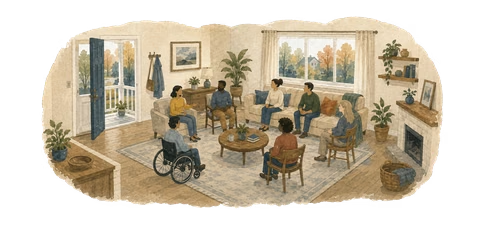 Find parent support
Support groups for parents, caregivers, and siblings across the region, in person and online. Start with the one closest to home.
Find parent support
Support groups for parents, caregivers, and siblings across the region, in person and online. Start with the one closest to home.
 Meet other local families
Spend an hour online with parents and caregivers who understand.
Meet other local families
Spend an hour online with parents and caregivers who understand.
 Find school help
How IEPs and 504 plans work in Tennessee, how to request a school evaluation in writing, and where to get free help.
Find school help
How IEPs and 504 plans work in Tennessee, how to request a school evaluation in writing, and where to get free help.
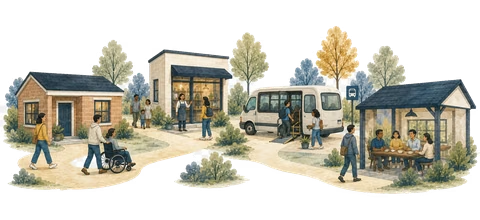 Find teen or adult services
Social groups, providers, and activities for teens, plus guides to benefits, work, housing, and planning for adult life.
Find teen or adult services
Social groups, providers, and activities for teens, plus guides to benefits, work, housing, and planning for adult life.
 Figure out payment or funding
Tennessee has several kinds of help families can combine. Learn which payment routes apply before you commit to anything.
Figure out payment or funding
Tennessee has several kinds of help families can combine. Learn which payment routes apply before you commit to anything.
 NewsletterOne helpful email each month: the month ahead, deadline watch, what’s new in the library, and one hopeful story. Free, and no spam.
 CalendarSensory-friendly events, support-group meetings, respite nights, and upcoming community programs around Middle Tennessee, updated regularly.
 Online Support GroupA free, low-pressure hour with parents and caregivers who understand, online every Thursday from 7:00–8:00 PM. Cameras are optional and meetings are not recorded.
 Village HallA monthly online conversation with a guest expert about one practical topic, followed by live Q&A. Registrants receive the presentation recording.